
INTERFACE BETWEEN SCIENCE AND THE AEROSPACE INDUSTRY

RESEARCH AND TRANSFER FOCUS ON AEROSPACE
APOC Bremen is intended to be the contact point for questions relating to science in the aerospace sector. APOC Bremen will connect scientists with each other and with industry and thus create greater visibility to the outside world.

Mission
We continuously develop the joint external image of Bremen as an aerospace location and jointly create a mission statement for a clear understanding of our field in business, research, teaching, politics and society. In addition, we promote communication, networking and cooperation between scientists at Bremen’s universities and research institutes, including interdisciplinary and transdisciplinary cooperation with non-technical and scientific departments, in order to fully exploit the great potential of our region for aerospace.
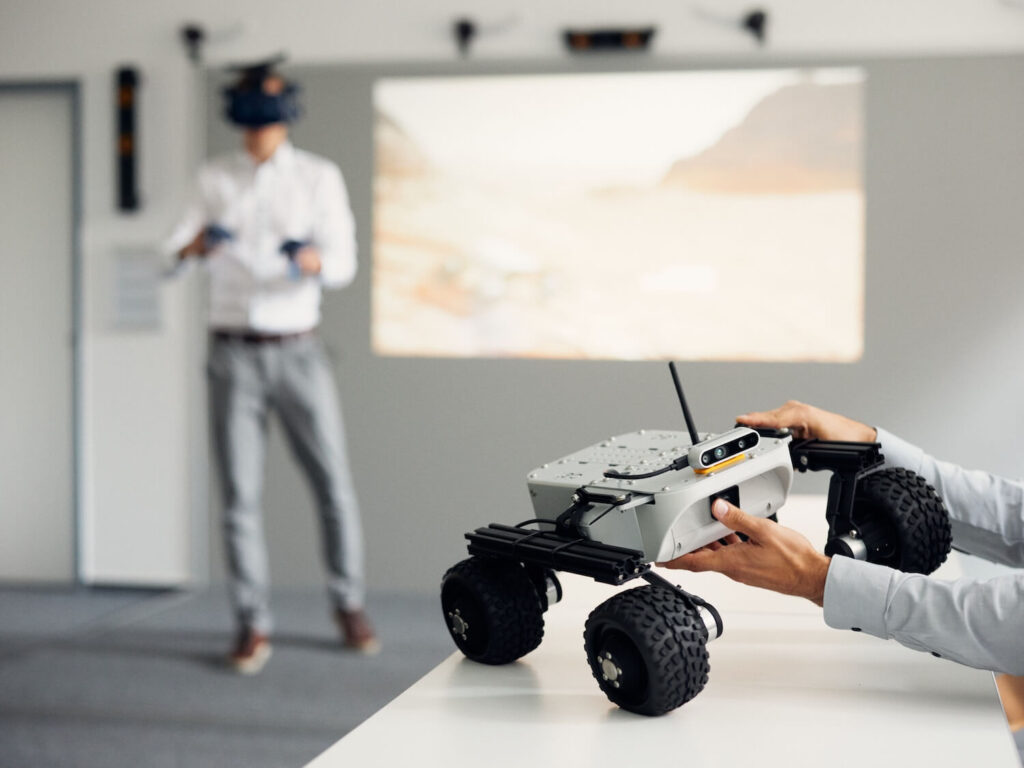
Vision
Together with our partners from society and industry, we will establish the state of Bremen as a world-leading aerospace location through excellent research, teaching and transfer.
AREAS OF RESEARCH
Aerospace is built on a very broad scientific foundation. This is why APOC Bremen covers the disciplines of physics, mathematics, engineering and materials science, electrical engineering, computer science, philosophy, biology, 3D printing, cognitive research, chemistry, robotics, information technologies, exploration research and many more. This is reflected in many interdisciplinary and cross-disciplinary projects and collaborations.
Bereich 1
Lorem ipsum dolor sit amet, consectetur adipiscing elit. Ut elit tellus.
Bereich 2
Lorem ipsum dolor sit amet, consectetur adipiscing elit. Ut elit tellus.
Bereich 3
Lorem ipsum dolor sit amet, consectetur adipiscing elit. Ut elit tellus.
Bereich 4
Lorem ipsum dolor sit amet, consectetur adipiscing elit. Ut elit tellus.
STEERING COMMITTEE
The APOC Bremen Steering Committee is made up of seven to nine people from Bremen’s research community and is elected for a period of two years by the General Assembly.
The tasks of the steering committee include
- The strategic planning and orientation of APOC Bremen,
- cooperation and communication with civil society, business, politics and science,
- initiating discussions on the role of science for Bremen as an aerospace location,
- developing and submitting research proposals to funding bodies,
- cooperation with the advisory board and the coordinator.


INSTITUTIONS
Further information on the research institutions of the members of the Steering Committee is summarized here.
Space travel is a key pillar for Bremen as a business location. It is a focal point of scientific research in the federal state. Prof. Dr. Jasminka Matevska and Prof. Dr. Antonio Garcia from Bremen University of Applied Sciences (HSB) make an important contribution with their work in teaching and research. One important aspect of this is to make space travel more sustainable. The two professors are pursuing this goal in different projects. For example, they both run the Airbus Café at HSB, where students from different disciplines come together to work on the future of space travel. The overarching topic is "Reusable Space Transportation Systems". The aim is to develop innovative concepts for making space travel more sustainable, economical and future-proof.
Prof. Dr. Jasminka Matevska also heads the international Master's degree course "Engineering and Management of Space Systems" (EMSS). It provides fundamental knowledge in the field of systems engineering and management, which is required for the planning, design, implementation and management of space missions.
Prof. Dr. Antonio Garcia is part of the management team of the Institute of Aerospace Technology (IAT) at HSB. At the IAT, scientists work together with students to research alternative fuels and propulsion systems in space travel. Examples include the "BreSpaceTech 2025+" project and the "VIBES Pioneer" satellite project.
Space travel is a key pillar for Bremen as a business location. It is a focal point of scientific research in the federal state. Prof. Dr. Jasminka Matevska and Prof. Dr. Antonio Garcia from Bremen University of Applied Sciences (HSB) make an important contribution with their work in teaching and research. One important aspect of this is to make space travel more sustainable. The two professors are pursuing this goal in different projects. For example, they both run the Airbus Café at HSB, where students from different disciplines come together to work on the future of space travel. The overarching topic is "Reusable Space Transportation Systems". The aim is to develop innovative concepts for making space travel more sustainable, economical and future-proof.
Prof. Dr. Jasminka Matevska also heads the international Master's degree course "Engineering and Management of Space Systems" (EMSS). It provides fundamental knowledge in the field of systems engineering and management, which is required for the planning, design, implementation and management of space missions.
Prof. Dr. Antonio Garcia is part of the management team of the Institute of Aerospace Technology (IAT) at HSB. At the IAT, scientists work together with students to research alternative fuels and propulsion systems in space travel. Examples include the "BreSpaceTech 2025+" project and the "VIBES Pioneer" satellite project.